
Web Application Engineering for Reliable Browser-Based Products
Modern web applications carry the weight of core business operations—from customer self-service portals and booking platforms to complex internal dashboards. We engineer browser-based applications that load quickly, handle state predictably and remain straightforward to maintain over years of iteration.
01 / Problem & Audience
When organisations need web application engineering.
Many web applications suffer from bloated front-end bundles, inconsistent state management, poor accessibility and fragile API contracts that cause regressions whenever a new feature is introduced.
Who This Service Is Designed For
- Product teams building customer-facing portals, booking systems or self-service applications
- Organisations replacing desktop-bound tools with secure browser-accessible applications
- Engineering teams needing structured front-end and full-stack architecture that scales cleanly
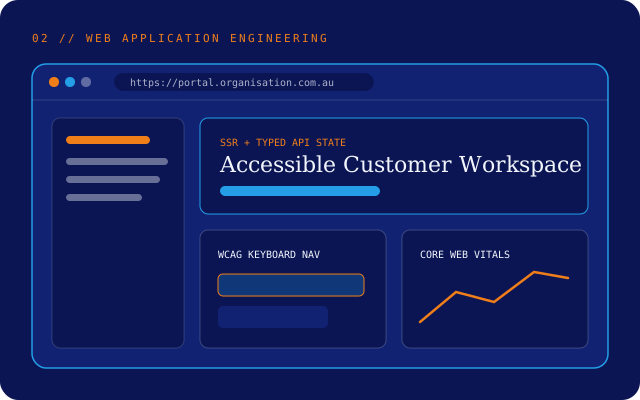
Reference Architecture Blueprint
Web Applications System Layers
02 / Scope & Process
How we scope and deliver web applications.
- Step 01
Information Architecture & State Planning
We define URL routing, permission boundaries, caching behaviour and client/server rendering strategies suited to your users and SEO requirements.
- Step 02
Component System & Accessibility Foundation
We establish reusable, keyboard-accessible UI components with consistent validation, loading and error states.
- Step 03
Full-Stack Feature Delivery
We connect front-end workflows to strongly typed APIs, implementing authentication, authorisation and resilient data fetching.
- Step 04
Performance & Cross-Browser Verification
Before launch we audit Core Web Vitals, bundle sizes, responsive breakpoints and assistive technology compatibility.
03 / Practical Benefits
Concrete operational outcomes.
Fast, Responsive Interfaces
Careful rendering choices and lean asset budgets keep interactions snappy across desktop and mobile connections.
WCAG-Aligned Accessibility
Semantic HTML, keyboard navigation, focus management and clear form semantics reduce friction for every user.
End-to-End Type Safety
Shared schemas between API responses and UI components catch contract mismatches at compile time rather than in production.
Resilient Error Handling
Graceful degradation, clear user feedback and structured telemetry make issues straightforward to diagnose.
04 / Concrete Deliverables
What your team receives
- ✓Responsive web application codebase (Next.js / React or approved stack)
- ✓Documented UI component library and design token configuration
- ✓Typed API client layer, authentication flows and session management
- ✓Automated browser and accessibility test coverage
- ✓Performance budget report and production build configuration
05 / Transparent Boundaries & Limitations
Honest scope conditions
Clear software engineering requires stating upfront what depends on external systems, client inputs or separate commercial tools:
- Browser capabilities have hardware constraints; if your workflow requires background Bluetooth polling or offline-first native hardware access, we will assess whether a Progressive Web App (PWA) or dedicated mobile app is more appropriate.
- Third-party embedded scripts (such as external chat widgets or tag managers) must be governed carefully to avoid degrading page performance.
06 / Common Questions
Web Applications FAQs
Do you build single-page applications (SPAs) or server-rendered web apps?
We choose the rendering model based on how the application is used. Public or search-indexed pages benefit from server rendering or static generation, while highly interactive authenticated workspaces often combine server data loading with rich client-side state.
How do you handle web application security?
We apply defence-in-depth practices aligned with OWASP guidelines, including strict input validation, Content Security Policy (CSP) headers, secure cookie attributes, CSRF protection and least-privilege API authorisation.
Can you work with our existing backend APIs?
Yes. We regularly build modern web interfaces on top of existing REST, GraphQL or enterprise services, introducing an adapter or backend-for-frontend layer where needed to keep the UI clean.
07 / Connected Capabilities & Reading
Related services & practical guide
UI/UX Product Design
Research real user workflows, test clickable prototypes early and design accessible, developer-ready interfaces.
Quality Assurance and Testing
Establish functional, regression, performance and security test automation that gives teams confidence to ship.
Custom Software Development
Define business requirements clearly and build tailored software around your operational reality.
Related Engineering Article · 7 min read
What to Test Before Launching a New Web Application
Passing happy-path feature demos on a developer laptop is only half the battle. A calm production launch requires structured verification across permissions, edge-case inputs, accessibility, performance and operational monitoring.
08 / Start a Conversation
Enquire about Web Application Engineering.
Share a few details about your current system or planned project. Our engineering team will review your requirements and reply within two Australian business days.