
Quality Assurance and Testing That Makes Releases Predictable
When every release requires days of nervous manual clicking—and still introduces regressions into production—engineering velocity grinds to a halt. We design pragmatic quality assurance strategies combining automated unit, API and end-to-end tests with structured exploratory and pre-launch verification.
01 / Problem & Audience
When organisations need quality assurance and testing.
Growing software teams frequently hit a wall where fixing one bug breaks two existing features, manual regression cycles take longer than writing the code, or flaky end-to-end tests are ignored by developers.
Who This Service Is Designed For
- Engineering teams experiencing frequent production regressions or slow manual release sign-offs
- Organisations preparing for a major product launch, migration or enterprise customer onboarding
- Teams needing automated CI test gates and repeatable test data environments
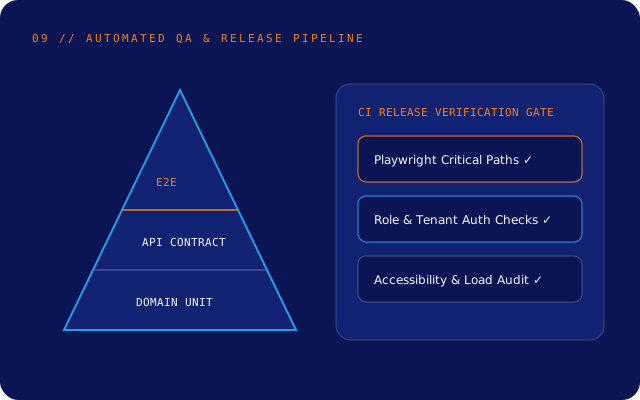
Reference Architecture Blueprint
QA & Testing System Layers
02 / Scope & Process
How we scope and deliver qa & testing.
- Step 01
Risk-Based Test Audit
We identify the highest-risk business workflows—such as checkout, billing, permissions, data mutations and integrations—where failure costs the most.
- Step 02
Test Pyramid & CI Architecture
We balance fast unit and API contract tests with deterministic browser end-to-end tests (such as Playwright) wired directly into pull-request checks.
- Step 03
Performance, Accessibility & Security Checks
We execute load testing against critical endpoints, automated + manual accessibility audits, and baseline application security checks.
- Step 04
Release Gate & Team Enablement
We establish deterministic test data seeding, eliminate flaky test patterns and train developers to maintain tests as part of everyday work.
03 / Practical Benefits
Concrete operational outcomes.
Fast Pull-Request Feedback
Developers learn within minutes if a change broke an API contract or critical user journey.
Deterministic, Non-Flaky Tests
Proper test isolation and seeded state prevent unreliable tests from eroding team trust.
Coverage Where It Counts
We prioritise high-consequence workflows (auth, permissions, calculations, integrations) over vanity coverage percentages.
Calm, Repeatable Releases
Structured pre-release checklists and automated smoke tests make deploying on any day of the week routine.
04 / Concrete Deliverables
What your team receives
- ✓Risk-prioritised test strategy and coverage matrix
- ✓Automated end-to-end browser and API integration test suites
- ✓CI pipeline integration with failure artifacts (traces, screenshots, logs)
- ✓Load/performance benchmark scripts and findings report
- ✓Pre-launch QA checklist and exploratory testing documentation
05 / Transparent Boundaries & Limitations
Honest scope conditions
Clear software engineering requires stating upfront what depends on external systems, client inputs or separate commercial tools:
- Testing reduces risk substantially and catches regressions early, but no testing process can mathematically guarantee the absence of all software defects across every possible third-party state.
- Formal penetration testing for regulatory compliance certifications (such as ISO 27001 or SOC 2) should be complemented by an accredited independent security auditor.
06 / Common Questions
QA & Testing FAQs
Why not just automate 100% of every screen with end-to-end browser tests?
End-to-end browser tests are slower and more sensitive to UI wording changes than unit or API tests. We reserve browser E2E tests for critical multi-step user journeys (like sign-up, permissions and core transactions) and test complex business rules at the unit and API layer where tests run in milliseconds.
Our existing automated tests fail randomly. Can you fix them?
Yes. Flaky tests are almost always caused by shared mutable database state, arbitrary sleep timers or unmocked third-party network calls. We refactor test suites to use isolated test data and deterministic state waits.
What do you check before launching a new web application?
Beyond functional workflows, we verify role authorisation boundaries, form validation, error pages, mobile responsiveness, keyboard accessibility, SEO metadata, backup restoration and production alerting.
07 / Connected Capabilities & Reading
Related services & practical guide
Web Application Engineering
Develop responsive, accessible and maintainable browser-based products and portals.
Software Maintenance and Support
Keep production software secure, monitored and steadily improving with structured support and upgrades.
Enterprise Software Modernisation
Assess legacy business systems and execute low-risk, incremental modernisation without halting operations.
Related Engineering Article · 7 min read
What to Test Before Launching a New Web Application
Passing happy-path feature demos on a developer laptop is only half the battle. A calm production launch requires structured verification across permissions, edge-case inputs, accessibility, performance and operational monitoring.
08 / Start a Conversation
Enquire about Quality Assurance and Testing.
Share a few details about your current system or planned project. Our engineering team will review your requirements and reply within two Australian business days.