
API Design and System Integration That Keeps Business Data Consistent
When customer orders, inventory updates or financial records live in separate systems, staff end up copying data by hand or relying on fragile scripts that fail silently. We design clean, documented APIs and engineer integration services that move data between approved platforms accurately and auditable.
01 / Problem & Audience
When organisations need api design and integration.
Point-to-point integrations often break when a third-party API times out, changes payload formats or sends duplicate webhook events—resulting in missing records, double-charged invoices and hours of manual reconciliation.
Who This Service Is Designed For
- Operations and finance teams eliminating manual CSV exports and double data entry between ERP, CRM and fulfilment systems
- Software teams publishing external APIs for partners or customers
- Organisations consolidating data flows across cloud SaaS tools and legacy internal databases
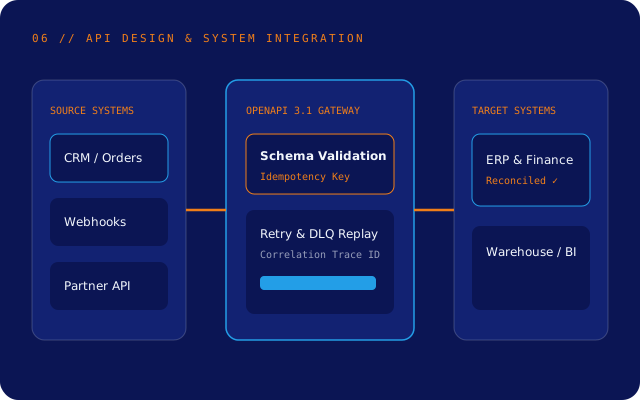
Reference Architecture Blueprint
APIs & Integration System Layers
02 / Scope & Process
How we scope and deliver apis & integration.
- Step 01
Data Flow & System Contract Audit
We map source-of-truth ownership for every entity, inspect upstream/downstream API limits and document field mappings and edge cases.
- Step 02
API Contract & Schema Specification
We author OpenAPI / JSON Schema specifications with explicit authentication, pagination, error codes and versioning rules.
- Step 03
Resilient Integration Engineering
We build connectors and middleware with idempotency keys, exponential backoff retries, dead-letter queues and schema validation.
- Step 04
Reconciliation & Monitoring Handover
We verify payloads against sandbox and production endpoints, setting up alerts so failed syncs are surfaced and replayable without data loss.
03 / Practical Benefits
Concrete operational outcomes.
No Silent Data Loss
Dead-letter queues, correlation IDs and structured alerts ensure failed transfers are captured and safely replayed.
Idempotent Processing
Duplicate webhooks or network retries will not create duplicate orders, contacts or invoices.
Clear Source-of-Truth Boundaries
Explicit ownership rules prevent two systems from overwriting each other with stale records.
Living API Documentation
OpenAPI specifications generated directly from code keep documentation accurate for internal and partner developers.
04 / Concrete Deliverables
What your team receives
- ✓OpenAPI 3.x specifications and integration sequence diagrams
- ✓Data mapping tables and source-of-truth governance matrix
- ✓Production integration service / middleware codebase
- ✓Automated contract tests and mock server fixtures
- ✓Operational dashboard for sync health, dead-letter inspection and replay
05 / Transparent Boundaries & Limitations
Honest scope conditions
Clear software engineering requires stating upfront what depends on external systems, client inputs or separate commercial tools:
- Integration capabilities are bounded by the rate limits, uptime and exposed endpoints of the third-party or legacy systems being connected.
- Where a third-party vendor does not provide a supported API or webhook mechanism, we will assess safe batch or database options rather than brittle screen-scraping.
06 / Common Questions
APIs & Integration FAQs
Should we use an off-the-shelf integration tool (iPaaS) or custom integration code?
Low-code tools like Zapier or Make work well for simple marketing automations. However, when you need complex business rule validation, high volume, strict version control, automated testing and reliable error replay across core operational systems, a small purpose-built integration service is usually more reliable and cost-effective.
What happens when a third-party API goes down temporarily?
We design integrations asynchronously wherever possible. Incoming events are acknowledged and queued, then processed with exponential backoff retries. If an upstream system stays down, failed messages move to a dead-letter queue and trigger an alert so they can be replayed once the vendor recovers.
Can you document our existing undocumented APIs?
Yes. We can audit existing endpoints, add runtime schema validation and generate interactive OpenAPI documentation so your team and partners have a single accurate reference.
07 / Connected Capabilities & Reading
Related services & practical guide
Custom Software Development
Define business requirements clearly and build tailored software around your operational reality.
Enterprise Software Modernisation
Assess legacy business systems and execute low-risk, incremental modernisation without halting operations.
Cloud Application Development
Engineer resilient cloud-hosted applications with clear infrastructure-as-code and cost governance.
Related Engineering Article · 6 min read
Why API Documentation Matters for Software Integrations
Most software integration overruns happen not because writing HTTP requests is hard, but because undocumented payload assumptions, silent rate limits and ambiguous error states surface late in testing.
08 / Start a Conversation
Enquire about API Design and Integration.
Share a few details about your current system or planned project. Our engineering team will review your requirements and reply within two Australian business days.