
Software Maintenance and Support That Protects Your Production Investment
Software is never truly "finished" the day it launches. Browser engines update, third-party APIs deprecate endpoints, security vulnerabilities are disclosed in open-source packages, and users discover improvements once they use the system daily. We provide structured maintenance, monitoring and iterative enhancement so your software stays healthy.
01 / Problem & Audience
When organisations need software maintenance and support.
Many applications are left untouched for two years after launch until an expired certificate, deprecated API or unpatched framework vulnerability causes an urgent outage that nobody is prepared to fix.
Who This Service Is Designed For
- Organisations without a full-time internal engineering team who need reliable stewardship for business-critical software
- Internal IT teams wanting a trusted partner to handle framework upgrades, security patching and backlog improvements
- Businesses transitioning a completed codebase from a previous vendor or contractor
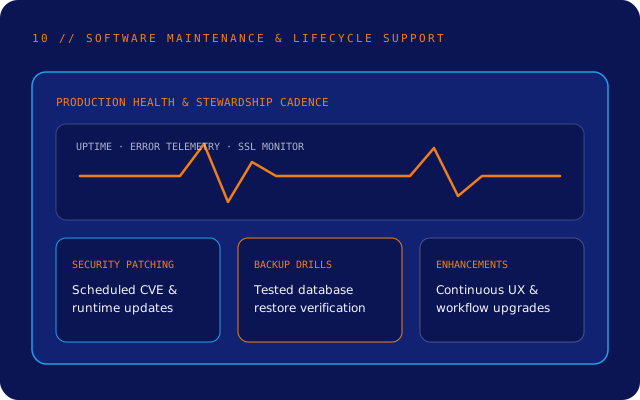
Reference Architecture Blueprint
Maintenance & Support System Layers
02 / Scope & Process
How we scope and deliver maintenance & support.
- Step 01
Codebase & Operational Onboarding
We audit repository access, deployment pipelines, backups, SSL/domain renewals, dependency health and monitoring alerts.
- Step 02
Preventative Maintenance & Patching Cadence
On a scheduled monthly cycle we apply security patches, runtime updates and dependency upgrades verified against automated tests.
- Step 03
Monitored Incident Response & Bug Resolution
We triage production alerts and user-reported defects using agreed severity classifications and documented runbooks.
- Step 04
Continuous Small Enhancements
Unused monthly capacity goes directly toward prioritised workflow improvements, reporting refinements and technical debt reduction.
03 / Practical Benefits
Concrete operational outcomes.
Avoid Expensive Emergency Upgrades
Steady monthly dependency updates prevent the multi-month crisis of jumping five major framework versions at once.
Verified Backups & Recovery
We do not just check that backups are scheduled—we periodically test restoring them to verify they actually work.
Retained System Knowledge
An active engineering partner who knows your architecture can diagnose issues or add features without weeks of ramp-up.
Predictable Monthly Budgeting
Capped monthly retainers with transparent reporting let you plan ongoing operating expenses clearly.
04 / Concrete Deliverables
What your team receives
- ✓Initial onboarding health report and risk remediation checklist
- ✓Configured uptime, error-rate and certificate-expiry monitoring
- ✓Scheduled dependency, OS/runtime and security patch releases
- ✓Periodic backup restoration verification records
- ✓Monthly activity summary covering patches, incidents and enhancements
05 / Transparent Boundaries & Limitations
Honest scope conditions
Clear software engineering requires stating upfront what depends on external systems, client inputs or separate commercial tools:
- Response times and coverage windows (such as Australian business hours vs extended coverage) are governed by the specific Service Level Agreement (SLA) agreed for your engagement.
- Taking over third-party codebases begins with a short onboarding audit so we can verify deployability and fix critical blockers before assuming SLA responsibility.
06 / Common Questions
Maintenance & Support FAQs
Can you maintain software that another agency or developer built?
Yes, provided the software is built on a mainstream stack and you own the source code. We always start with a fixed-scope codebase and infrastructure onboarding audit to verify we can build, test and deploy the application safely.
What happens if we do not have any bugs in a given month?
First, preventative maintenance (security patches, dependency updates and backup verification) happens every month regardless. Beyond that, any remaining hours in your monthly allocation are used for prioritised small features, UX improvements or performance tuning.
How are urgent production issues handled?
We define clear severity levels during onboarding—separating critical system-down incidents from minor UI defects—along with direct escalation channels and documented rollback procedures.
07 / Connected Capabilities & Reading
Related services & practical guide
Enterprise Software Modernisation
Assess legacy business systems and execute low-risk, incremental modernisation without halting operations.
Quality Assurance and Testing
Establish functional, regression, performance and security test automation that gives teams confidence to ship.
Cloud Application Development
Engineer resilient cloud-hosted applications with clear infrastructure-as-code and cost governance.
Related Engineering Article · 8 min read
How to Modernise Legacy Business Software Safely
Big-bang software rewrites frequently run over budget because legacy systems contain years of undocumented business rules. Incremental modernisation delivers value faster with far lower operational risk.
08 / Start a Conversation
Enquire about Software Maintenance and Support.
Share a few details about your current system or planned project. Our engineering team will review your requirements and reply within two Australian business days.