
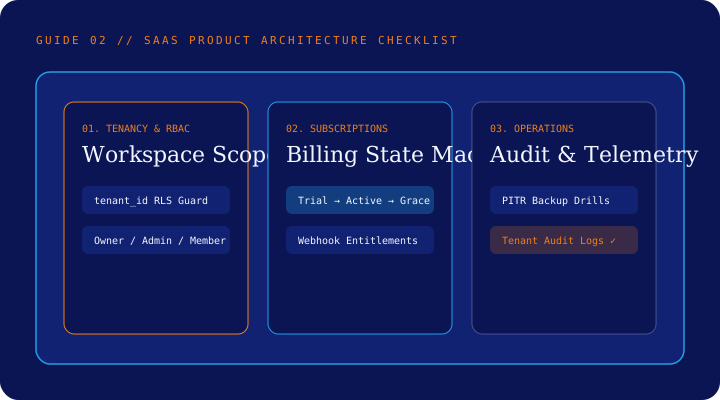
Executive Summary & Key Takeaways
What technical and product foundations do you need to plan before building a SaaS application?
- Define your tenancy model (pooled row-level isolation vs isolated schemas) before writing database queries.
- Model accounts as Organisations/Workspaces with Role-Based Access Control (RBAC) from day one—never assume one user equals one customer.
- Delegate payment card handling and tax invoicing to a dedicated billing engine, and drive product access through webhook entitlements.
- Keep your V1 scope ruthlessly focused on the core domain workflow that convinces a customer to pay.
1. Validate the Core Workflow Before Building SaaS Plumbing
The most common mistake in early SaaS engineering is spending two months building elaborate billing tiers, settings screens and notification preferences before validating whether users actually value the core workflow.
Start with interactive UI/UX prototypes and test them with five to ten target buyers. Confirm what data they need to import on day one, what outcome they expect within their first 15 minutes in the product, and who in their organisation needs to approve the purchase.
2. Design Multi-Tenancy and Workspaces Early
Retrofitting multi-tenancy onto a single-user codebase is slow and error-prone. Even if your first customers only have a single login, structure your data model so that Users belong to an Organisation (or Workspace), and all domain records belong to that Organisation.
For most B2B SaaS products, a shared relational database with mandatory tenant-ID scoping (enforced via application middleware and database row-level security policies) provides the best balance of cost and maintainability. If you sell into highly regulated enterprise sectors, design your persistence layer so high-tier tenants can be provisioned into isolated schemas or dedicated instances.
Architecture Tip
Never pass tenant_id as an unverified client query parameter. Always derive the active tenant context from the authenticated session or cryptographic token on the server.
3. Authentication, Roles and Subscription States
B2B customers expect team invitations, role separation (such as Owner, Admin, Member and Read-Only Auditor), multi-factor authentication and eventually Single Sign-On (SSO). Using a well-architected authentication foundation avoids security pitfalls around password resets and session revocation.
Similarly, treat subscription billing as a state machine driven by webhooks from your billing platform. Your application should gracefully handle trial expiry, plan upgrades, failed payment grace periods and read-only states without corrupting customer data.
4. Operational Readiness: Backups, Audit Logs and Onboarding
Before onboarding paying customers, verify how you will support them. Every production SaaS platform needs automated point-in-time database backups (with tested restore procedures), tenant-scoped audit logs showing who changed what and when, and structured error telemetry so your engineering team sees failures before a customer writes a support ticket.
Practical Verification Tool
SaaS V1 Architecture & Launch Readiness Checklist
- ✓Clickable prototype tested with target buyers to confirm the minimum lovable V1 scope
- ✓Database schema scoped around Organisations/Workspaces rather than individual user IDs
- ✓Role-Based Access Control (RBAC) and team invitation flows mapped out
- ✓Subscription lifecycle states defined (Trialing, Active, Past Due, Cancelled / Read-Only)
- ✓Automated database backups, Australian or regional data residency, and tenant audit logging configured
- ✓CI/CD pipeline with staging environment and automated smoke tests in place
Apply This to Your Project
Planning a new SaaS product or multi-tenant platform?
Talk with our SaaS product engineering team about scoping your V1 architecture, prototyping user flows and building a secure multi-tenant foundation.