
SaaS Product Engineering from First Release to Multi-Tenant Scale
Building a Software-as-a-Service product involves far more than core feature screens. Tenant data isolation, role-based access control, subscription lifecycle states, customer onboarding and operational observability determine whether a SaaS business can scale sustainably. We partner with founders and product leaders to architect and build durable SaaS platforms.
01 / Problem & Audience
When organisations need saas product engineering.
Early SaaS builds often hardcode single-customer assumptions, making it painful to add enterprise SSO, tiered entitlements, audit logs or strict tenant data separation when larger customers ask for security reviews.
Who This Service Is Designed For
- B2B SaaS founders and product teams moving from concept or prototype to a commercial V1 release
- Established software vendors re-architecting single-tenant deployments into a multi-tenant cloud platform
- Industry specialists turning internal proprietary tools into commercial subscription products
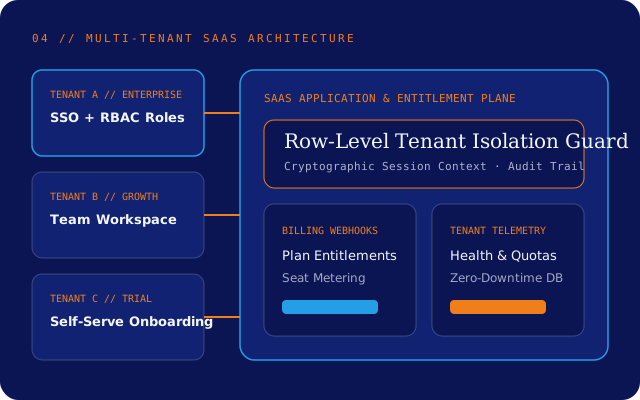
Reference Architecture Blueprint
SaaS Engineering System Layers
02 / Scope & Process
How we scope and deliver saas engineering.
- Step 01
Product Scope & Tenancy Architecture
We define the minimum lovable product scope alongside the tenancy model (pooled, schema-isolated or dedicated) required by your target market.
- Step 02
Identity, Entitlements & Billing Foundation
We implement organisation workspaces, user invitations, role permissions and subscription webhook handling using proven identity and billing providers.
- Step 03
Core Product Engineering & Telemetry
We build the product features that differentiate your offering while embedding structured usage events and operational health checks.
- Step 04
Launch Readiness & Iteration Cadence
We prepare production environments, backup policies, tenant provisioning tools and a repeatable release cadence for post-launch feedback.
03 / Practical Benefits
Concrete operational outcomes.
Security-Review Ready
Clear tenant isolation, audit logging and role boundaries help you answer enterprise procurement questionnaires with confidence.
Clean Subscription Lifecycle
Trials, upgrades, seat changes, grace periods and cancellations are handled deterministically through idempotent billing webhooks.
Focus R&D on Differentiators
We use battle-tested components for auth and billing so engineering budget goes into the domain features your customers pay for.
Observable Tenant Health
Per-tenant error tracking and performance metrics let your team spot onboarding friction or noisy-neighbour bottlenecks early.
04 / Concrete Deliverables
What your team receives
- ✓Multi-tenant SaaS application architecture and codebase
- ✓Workspace, role-based access control (RBAC) and invitation flows
- ✓Subscription billing and entitlement integration
- ✓Tenant administration, audit logging and provisioning utilities
- ✓Production deployment pipeline, backup verification and operational runbooks
05 / Transparent Boundaries & Limitations
Honest scope conditions
Clear software engineering requires stating upfront what depends on external systems, client inputs or separate commercial tools:
- Commercial success depends on market demand and customer acquisition; our role is to validate product feasibility and engineer a reliable platform rather than make revenue projections.
- Payment processing and tax compliance rely on configured accounts with your chosen merchant/billing provider (such as Stripe).
06 / Common Questions
SaaS Engineering FAQs
Should we share a single database across all SaaS customers or separate them?
Most B2B SaaS products start with a shared database using strict tenant-ID scoping and row-level security policies, which keeps operational overhead low. For regulated enterprise tiers, we can design the data layer so high-compliance tenants can be isolated in dedicated schemas or databases.
How long does it take to build a first commercial SaaS version?
After a two-week discovery phase, we typically deliver a clickable prototype immediately and a focussed initial release within two to three months, depending on integration complexity. We aggressively cut non-essential scope so you can learn from real paying users sooner.
Do you build custom billing engines from scratch?
Rarely. Integrating a dedicated billing platform like Stripe Billing is far safer for PCI compliance, invoicing and dunning management. We engineer the entitlement and webhook synchronisation layer that connects billing status to your product features.
07 / Connected Capabilities & Reading
Related services & practical guide
Cloud Application Development
Engineer resilient cloud-hosted applications with clear infrastructure-as-code and cost governance.
UI/UX Product Design
Research real user workflows, test clickable prototypes early and design accessible, developer-ready interfaces.
Web Application Engineering
Develop responsive, accessible and maintainable browser-based products and portals.
Related Engineering Article · 8 min read
A Practical Checklist for Planning a SaaS Product
Turning a software idea or internal tool into a commercial SaaS product requires early decisions on tenant isolation, workspace permissions, subscription lifecycles and operational visibility.
08 / Start a Conversation
Enquire about SaaS Product Engineering.
Share a few details about your current system or planned project. Our engineering team will review your requirements and reply within two Australian business days.