
Executive Summary & Key Takeaways
What is the safest way to modernise an aging legacy software system without disrupting daily business operations?
- Resist the urge to announce a multi-year "from scratch" rewrite before mapping what the legacy system actually does.
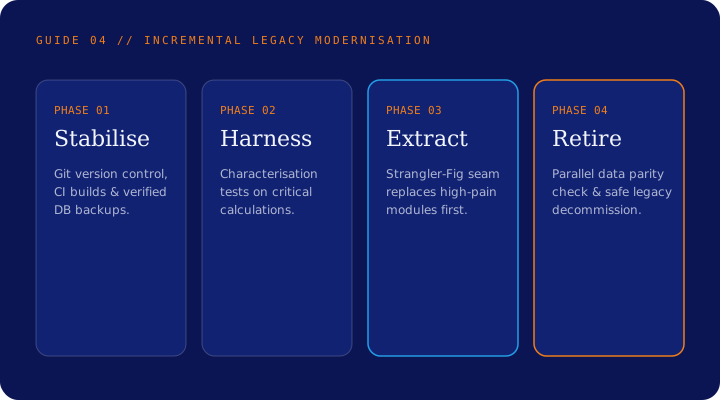
- Start by building a safety net: version control, reproducible builds, database backups and characterisation tests around critical outputs.
- Use the Strangler Fig pattern to extract and replace high-pain workflows one module at a time behind a clean routing or API seam.
- Run automated data reconciliation checks in parallel before retiring any legacy database table or calculation module.
1. Why "Big-Bang" Rewrites Are So Dangerous
When an older application becomes slow to change, hard to host or frustrating to use, the natural temptation is to freeze it and build a brand-new replacement from scratch. On paper, a clean slate looks faster than untangling old code.
In practice, legacy systems are full of hidden institutional memory: tax edge cases, customer-specific pricing exceptions, regulatory rules and subtle data validations added over a decade. When a team attempts a big-bang rewrite, they spend 18 months chasing a moving target while the business still needs changes in the old system—often ending up with two incomplete systems and exhausted stakeholders.
2. Step One: Stabilise the Patient Before Operating
Safe modernisation starts with removing immediate operational fragility. Before refactoring architecture or redesigning screens, establish four baseline guardrails:
- Reproducible Builds & Version Control: Ensure the exact code running in production is in Git and can be built and deployed automatically without manual server edits.
- Verified Database Backups: Confirm automated backups exist and practice restoring them into an isolated staging environment.
- Error & Performance Visibility: Add basic application logging and database query monitoring so you have objective data on what is actually failing or slow.
- Characterisation Tests: Write automated tests that capture the current inputs and outputs of critical calculations or API endpoints so you know immediately if a change alters business behaviour.
3. Incremental Replacement Using the Strangler Fig Pattern
Once a safety net is in place, rank parts of the system along two axes: business pain (how much does this module slow down staff or customers?) and coupling (how cleanly can we draw a boundary around it?).
Using the Strangler Fig approach, we place a modern routing or API layer in front of the legacy application. We then build the highest-value modernised module—for example, a new customer quoting portal or an automated reporting service—and route traffic for just that workflow to the new module while the rest of the legacy application continues running undisturbed.
De-Risking Cutovers
Shipping a modernised slice into production every few weeks proves the architecture early and delivers immediate relief to staff, rather than gambling everything on a single launch day a year away.
4. Migrating Data with Parallel Verification
Code can be rolled back in seconds; corrupted production data cannot. When modernising database schemas, avoid manual one-off SQL scripts run on launch night. Instead, build repeatable migration pipelines accompanied by automated reconciliation checks that verify row counts, financial totals and referential integrity between old and new structures.
Practical Verification Tool
Legacy Software Modernisation Safety Checklist
- ✓Production source code, configuration and database schema changes are 100% tracked in version control
- ✓Database backups have been restored and verified in a non-production environment
- ✓Top 3 operational bottlenecks identified through user interviews and system telemetry
- ✓Characterisation or regression tests written around high-risk business calculations
- ✓Routing or API facade seam established so workflows can be cut over individually with instant rollback
- ✓Automated data reconciliation script written to verify parity before retiring legacy tables
Apply This to Your Project
Dealing with a critical legacy system that feels risky to touch?
We conduct pragmatic legacy codebase and architecture assessments to give you a clear, incremental modernisation roadmap without halting daily operations.