
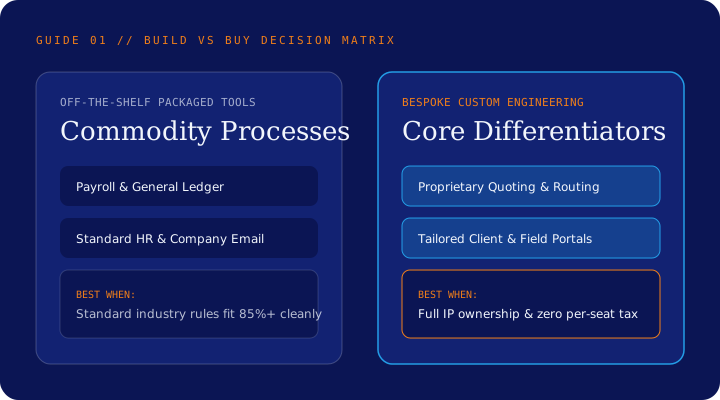
Executive Summary & Key Takeaways
How do you decide whether to buy an off-the-shelf software package or build custom software for your business?
- Buy off-the-shelf software for commodity processes like payroll, standard accounting and basic email marketing.
- Build custom software when a workflow is central to how your business competes, prices, schedules or delivers value.
- Calculate total cost over three to five years—including per-seat licensing, connector subscriptions and staff hours spent on manual workarounds.
- Consider a hybrid approach: keep standard platforms as systems of record and build a focused custom layer for your proprietary operations.
1. Separate Commodity Processes from Differentiating Workflows
Every organisation runs two kinds of processes: standard operational hygiene that works the same way across thousands of companies, and domain-specific workflows that define why customers choose you over a competitor.
For commodity functions—such as general ledger accounting, standard HR leave tracking, company email or basic CRM contact lists—buying a proven off-the-shelf platform is almost always the right call. The vendor spreads compliance and maintenance costs across thousands of tenants, and your team can adopt industry-standard practices immediately.
The calculus flips when the process is your core operational differentiator. If your business relies on complex multi-variable quoting, specialised field-inspection logic, custom manufacturing or logistics routing, or regulatory workflows unique to your sector, off-the-shelf tools rarely fit without heavy distortion.
Practical Rule of Thumb
If adapting your team to match the software improves discipline, buy off-the-shelf. If adapting your team to match the software destroys your operational advantage, build custom.
2. Five Signs You Have Outgrown Packaged Software
Most teams do not wake up wanting to commission custom software. Instead, they notice that their existing stack of SaaS subscriptions and spreadsheets is quietly slowing down daily operations.
- The "Shadow Spreadsheet" Problem: Staff export CSVs from your expensive software package into Excel to run the real calculations, then type the results back in.
- Fragile Automation Chains: You rely on dozens of brittle no-code zaps or scripts to glue three separate platforms together, and nobody notices when one silently fails.
- Per-Seat Licensing Penalties: You avoid giving field staff, contractors or clients access to a portal because adding 200 occasional users would double your annual software bill.
- Vendor Customisation Lock-In: Paying implementation consultants to bend an enterprise platform with proprietary scripting costs as much as custom engineering—while still leaving you locked into annual licence renewals.
- Customer Experience Bottlenecks: You cannot offer clients self-service visibility, live status tracking or tailored reporting because your packaged tool has a rigid portal template.
3. Comparing Total Cost Over Three to Five Years
Off-the-shelf software looks inexpensive in month one because upfront capital cost is low. Custom software has a higher upfront engineering investment during discovery and build, followed by modest, predictable cloud hosting and maintenance costs.
When comparing the two, model a three-to-five-year horizon. Include annual per-user licence tiers, paid add-on modules, third-party integration middleware, and—most importantly—the weekly wage cost of staff performing manual double-entry or reconciliation around the packaged tool’s limitations.
4. The Hybrid Middle Ground: Custom Workflow Layers
Choosing custom software does not mean replacing every system in your business. Often the highest-return architecture is a focused custom web or mobile application that handles your unique customer or operational workflow, connected cleanly via API to your existing accounting, ERP or identity platform.
By combining custom software development with disciplined UI/UX product design and API integration, you build only what makes your business faster and clearer—while letting commodity platforms handle the rest.
Practical Verification Tool
Build vs Buy Decision Checklist
- ✓Have we mapped the exact workflow steps where staff currently fall back to spreadsheets or manual copying?
- ✓Does an existing off-the-shelf tool cover at least 80% of this workflow without custom scripting?
- ✓What is our projected 3-year per-seat and add-on licensing cost as headcount or customer volume grows?
- ✓Do we need full ownership of the user interface, data model and roadmap for competitive reasons?
- ✓Can we build a focused custom layer that integrates with our existing accounting/ERP system rather than replacing everything?
Apply This to Your Project
Weighing up a custom build against packaged tools?
We run fixed-scope discovery engagements to map your workflows, evaluate off-the-shelf options honestly, and prototype the right path before you commit to full engineering.