
Custom Software Development Built Around How Your Business Actually Works
Off-the-shelf software works well for standard processes, but forcing unique operational logic into rigid templates creates manual workarounds, spreadsheet silos and brittle integrations. We help you define exact business requirements and engineer maintainable custom software that fits.
01 / Problem & Audience
When organisations need custom software development.
Organisations often outgrow packaged software when their competitive advantage depends on proprietary workflows, complex quoting or scheduling rules, multi-party approvals, or specialised domain data that generic platforms cannot model cleanly.
Who This Service Is Designed For
- Operations and technology leaders replacing fragmented spreadsheets and manual handoffs
- Australian mid-market enterprises with domain-specific compliance or workflow rules
- Teams whose licensing and customisation costs on packaged platforms now exceed the cost of purpose-built software
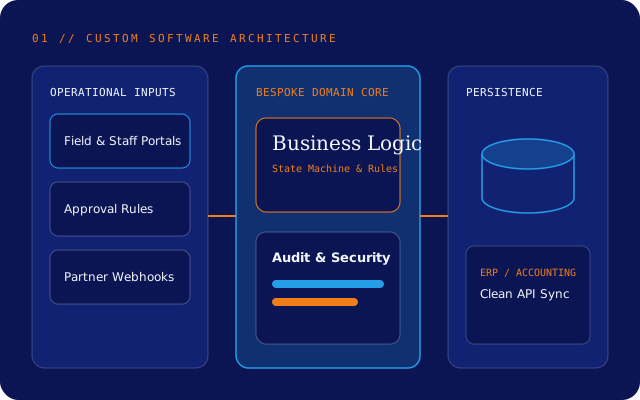
Reference Architecture Blueprint
Custom Software System Layers
02 / Scope & Process
How we scope and deliver custom software.
- Step 01
Operational Discovery & Requirements Mapping
We shadow key workflows, interview domain users, and document data models, edge cases and acceptance criteria before proposing an architecture.
- Step 02
Architecture & Prototype Validation
We validate user flows and system boundaries using interactive prototypes and technical spikes so stakeholders agree on scope before heavy engineering begins.
- Step 03
Iterative Engineering & Fortnightly Demos
Software is built in your source repository with automated test coverage, CI/CD pipelines and working increments demonstrated every two weeks.
- Step 04
Operational Handover & Evolution
We support production rollout, user onboarding, runbook documentation and structured handover to your internal team or ongoing support arrangement.
03 / Practical Benefits
Concrete operational outcomes.
Aligned to Real Workflows
Software reflects your actual rules and terminology rather than forcing staff to adapt to generic software assumptions.
Full Code & IP Ownership
All source code, infrastructure templates and documentation live in your repositories without per-seat vendor lock-in.
Designed for Maintainability
Modular boundaries, typed interfaces and automated tests mean future engineers can extend the system safely.
Transparent Scope Control
Clear trade-off discussions during discovery prevent unnecessary features from inflating timelines and budgets.
04 / Concrete Deliverables
What your team receives
- ✓Discovery specification, domain model and prioritised backlog
- ✓System architecture decision records (ADRs) and security model
- ✓Production-ready application source code in your Git repository
- ✓Automated unit, integration and end-to-end test suites
- ✓Deployment pipeline, operational runbooks and handover documentation
05 / Transparent Boundaries & Limitations
Honest scope conditions
Clear software engineering requires stating upfront what depends on external systems, client inputs or separate commercial tools:
- Where standard commoditised functions (such as basic payroll or general ledger accounting) are better served by existing commercial tools, we recommend integrating with those tools rather than rebuilding them from scratch.
- Project timelines depend on timely access to subject-matter experts for workflow verification and user acceptance testing.
06 / Common Questions
Custom Software FAQs
How do we know if we need custom software or an off-the-shelf tool?
During initial discovery we evaluate whether your problem can be solved by configuring an existing platform. We only recommend custom engineering when the workflow is core to your operations and off-the-shelf tools require excessive workarounds.
Can our internal developers work alongside your team?
Yes. Because we work directly in your repository with standard pull requests, code reviews and documentation, your internal engineers can collaborate from day one and take over smoothly.
What technology stacks do you use for custom builds?
We select proven, widely supported technologies suited to your team and hosting environment—typically TypeScript, React/Next.js, Node.js or .NET/Python backends, and PostgreSQL on mainstream cloud providers.
07 / Connected Capabilities & Reading
Related services & practical guide
Web Application Engineering
Develop responsive, accessible and maintainable browser-based products and portals.
API Design and Integration
Connect business systems reliably using documented contracts, idempotent workflows and clear observability.
UI/UX Product Design
Research real user workflows, test clickable prototypes early and design accessible, developer-ready interfaces.
Related Engineering Article · 7 min read
When Should a Business Choose Custom Software Over Off-the-Shelf Tools?
Defaulting to off-the-shelf software is usually right for standard business functions—until workarounds, per-seat fees and fragmented spreadsheets start costing more than building purpose-fit software.
08 / Start a Conversation
Enquire about Custom Software Development.
Share a few details about your current system or planned project. Our engineering team will review your requirements and reply within two Australian business days.