
Executive Summary & Key Takeaways
Why is comprehensive API documentation critical when connecting business software systems?
- API documentation is an executable contract between teams and systems—not an afterthought written after launch.
- Good documentation covers authentication, pagination, rate limits, error codes, webhook signatures and idempotency—not just happy-path JSON examples.
- Generating OpenAPI specifications directly from typed code schemas prevents documentation from drifting out of sync.
- Clear integration documentation slashes onboarding time for internal developers, external partners and future maintainers.
2. What Production-Grade API Documentation Must Include
A list of URL endpoints is not enough to build a reliable business integration. Whether you are documenting an internal API or evaluating a third-party platform, production-ready documentation needs to specify the full operational contract:
- Authentication & Token Lifecycle: Exact headers, OAuth2 scopes, token expiry windows and refresh flows.
- Strict Request & Response Schemas: Data types, string formats (ISO 8601 dates, currency minor units), enum values and required vs optional fields.
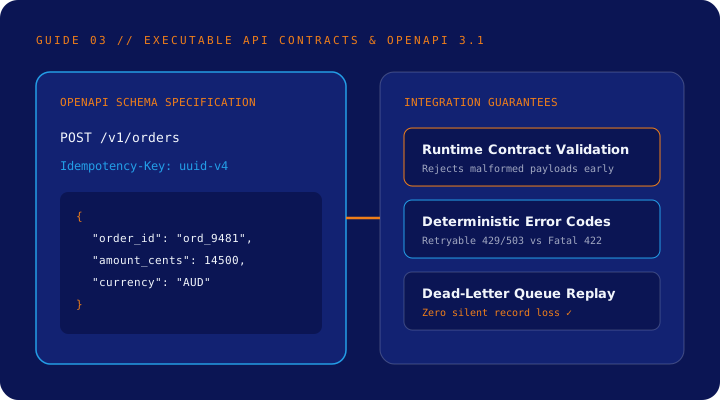
- Idempotency & Retry Semantics: How a caller can safely retry a timed-out POST or PATCH request without creating duplicate invoices or orders.
- Deterministic Error Payloads: Machine-readable error codes and field-level validation messages so integrations know whether to retry or alert an operator.
- Pagination, Filtering & Rate Limits: Cursor or offset rules, maximum page sizes and HTTP 429 retry-after behaviour.
- Webhook Verification & Ordering: Cryptographic signature verification headers, retry schedules and how to handle out-of-order event delivery.
3. Keeping Documentation Honest with Code-Driven Schemas
Manually maintained wiki pages inevitably drift out of date the moment a developer adds a field under deadline pressure. The solution is to treat your schema definition as the single source of truth.
In our API design and integration projects, we use runtime schema validators (or contract-first OpenAPI 3.x definitions) that simultaneously validate incoming payloads, generate TypeScript types and publish interactive API reference documentation in CI. If the code changes, the documentation and contract tests update in the same pull request.
Integration Principle
If an API behaviour is not tested against a schema and documented in version control, downstream systems cannot safely rely on it.
4. Documenting Source-of-Truth and Failure Recovery
Beyond individual endpoints, multi-system integrations need an architecture runbook that answers two operational questions: Which system is the authoritative source of truth for each field, and how does an operator inspect and replay a failed message from the dead-letter queue?
Having these answers documented before launch turns integration maintenance from stressful guesswork into a predictable operational routine.
Practical Verification Tool
API Contract & Integration Documentation Checklist
- ✓OpenAPI 3.x specification committed to version control and validated in CI
- ✓Authentication, token refresh and permission scopes documented with working examples
- ✓Idempotency keys supported and documented for all state-mutating endpoints
- ✓Standardised error response schema distinguishing transient (retryable) from permanent errors
- ✓Source-of-truth matrix defining which system owns each business entity and field
- ✓Runbook explaining how to inspect dead-letter queues and replay failed webhook or sync events
Apply This to Your Project
Need to connect core systems or design a clean partner API?
Our engineering team designs OpenAPI-documented interfaces and resilient integration middleware that keep your ERP, CRM and custom software in sync.