
Enterprise Software Modernisation Without the Big-Bang Rewrite Risk
Legacy systems often look outdated on the surface yet hold years of unwritten business rules that keep the company running. Throwing everything away in a multi-year "big-bang" rewrite is one of the highest-risk projects an organisation can attempt. We assess existing systems honestly and modernise them in safe, measurable increments.
01 / Problem & Audience
When organisations need enterprise software modernisation.
Organisations rely on aging software where the original authors have left, deployments are manual and risky, security patches are overdue, or database bottlenecks block new customer-facing capabilities.
Who This Service Is Designed For
- CIOs, CTOs and operations directors managing critical legacy applications with rising maintenance risk
- Businesses blocked from integrating modern cloud tools because core data is trapped in an older system
- Teams recovering from a stalled rewrite who need a pragmatic incremental path forward
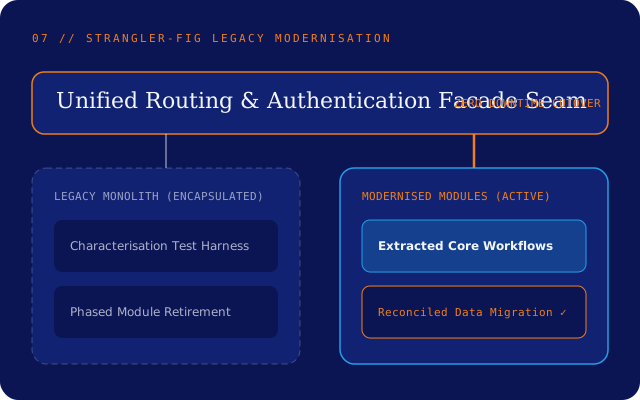
Reference Architecture Blueprint
Software Modernisation System Layers
02 / Scope & Process
How we scope and deliver software modernisation.
- Step 01
Technical & Domain Archaeology
We audit the existing codebase, database schema, deployment process and actual user workflows to separate essential business logic from dead code.
- Step 02
Safety Net & Automated Harness
Before changing core logic, we introduce version control, automated builds, characterisation tests and database backup verification.
- Step 03
Strangler-Fig Incremental Replacement
We extract and modernise the highest-pain modules first—running new and legacy components side-by-side behind clean routing or API seams.
- Step 04
Data Migration & Legacy Decommissioning
We run parallel data verification, cut over traffic slice by slice with instant rollback plans, and retire legacy infrastructure safely.
03 / Practical Benefits
Concrete operational outcomes.
Continuous Business Continuity
Incremental cutovers mean staff and customers keep working while high-risk modules are upgraded beneath the surface.
Preserved Institutional Knowledge
Hidden edge cases in existing code and database triggers are documented and tested rather than accidentally forgotten.
Early Return on Investment
Fixing the most painful bottleneck in month two delivers immediate value instead of waiting 18 months for a total rewrite.
Reduced Security & Key-Person Risk
Upgraded runtimes, documented architecture and automated deployments remove single-person dependencies.
04 / Concrete Deliverables
What your team receives
- ✓Legacy system health audit, risk register and modernisation roadmap
- ✓Characterisation test suite and automated build/deployment pipeline
- ✓Modernised application modules and API abstraction seams
- ✓Verified data migration scripts with reconciliation checks
- ✓Updated system documentation and legacy decommissioning checklist
05 / Transparent Boundaries & Limitations
Honest scope conditions
Clear software engineering requires stating upfront what depends on external systems, client inputs or separate commercial tools:
- Modernisation requires read access to existing source code, database schemas and production-representative test data to verify edge cases accurately.
- Where legacy systems depend on unsupported third-party hardware or proprietary closed binaries without source code, replacement boundaries must be planned around those interfaces.
06 / Common Questions
Software Modernisation FAQs
Should we rebuild or fix our old system?
Usually neither, at first. We map what the old system does that people rely on, put a deployment and testing safety net around it, and then replace or fix the parts that cost the most. A full rebuild is justified only when the underlying platform blocks every move and the domain is small enough to replace cleanly.
What is the "Strangler Fig" pattern?
Instead of rewriting an entire system at once, we place a routing or API layer in front of the old system and build new features or replacement modules alongside it. Traffic is routed to the new modules one workflow at a time until the old system shrinks and can be turned off safely.
How do you prevent data loss when migrating old databases?
We write automated migration and reconciliation scripts that compare row counts, checksums and business totals between the old and new schemas, testing them repeatedly against anonymised snapshots before any production cutover.
07 / Connected Capabilities & Reading
Related services & practical guide
API Design and Integration
Connect business systems reliably using documented contracts, idempotent workflows and clear observability.
Cloud Application Development
Engineer resilient cloud-hosted applications with clear infrastructure-as-code and cost governance.
Quality Assurance and Testing
Establish functional, regression, performance and security test automation that gives teams confidence to ship.
Related Engineering Article · 8 min read
How to Modernise Legacy Business Software Safely
Big-bang software rewrites frequently run over budget because legacy systems contain years of undocumented business rules. Incremental modernisation delivers value faster with far lower operational risk.
08 / Start a Conversation
Enquire about Enterprise Software Modernisation.
Share a few details about your current system or planned project. Our engineering team will review your requirements and reply within two Australian business days.