
Cloud Application Development Built for Resilience and Predictable Cost
Cloud platforms offer immense flexibility, but poorly structured cloud applications often end up Either over-engineered—with dozens of microservices a small team cannot maintain—or fragile, relying on manually clicked console settings that nobody dares touch. We design and build cloud-native applications with right-sized architecture and repeatable infrastructure-as-code.
01 / Problem & Audience
When organisations need cloud application development.
Teams frequently struggle with environment drift between staging and production, unexpected cloud bill spikes, manual deployment bottlenecks and inadequate visibility when background workloads fail.
Who This Service Is Designed For
- Engineering and operations teams deploying new cloud workloads on AWS, Microsoft Azure or Google Cloud
- Businesses migrating on-premises or manually managed servers to reproducible cloud environments
- Organisations seeking better reliability, automated scaling and clearer cloud cost attribution
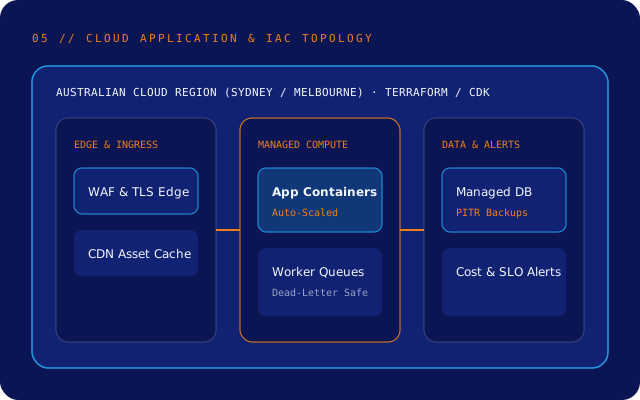
Reference Architecture Blueprint
Cloud Applications System Layers
02 / Scope & Process
How we scope and deliver cloud applications.
- Step 01
Workload & Operational Assessment
We analyse traffic patterns, data residency requirements (such as Australian regions), recovery objectives (RPO/RTO) and team operational capacity.
- Step 02
Right-Sized Cloud Architecture
We select managed services—containers, serverless functions, managed databases and queues—that minimise operational toil without locking you into obscure proprietary primitives.
- Step 03
Infrastructure-as-Code & CI/CD
Every network rule, database parameter and compute service is codified in version control so staging and production environments are reproducible.
- Step 04
Observability, Security & Cost Guardrails
We configure structured logging, actionable alerts, least-privilege IAM roles, secret management and budget anomaly alerts.
03 / Practical Benefits
Concrete operational outcomes.
Reproducible Environments
Infrastructure-as-Code eliminates "works on staging, fails in prod" configuration drift.
Right-Sized Complexity
We favour modular monoliths and managed services over unnecessary microservice sprawl that slows down small teams.
Australian Data Residency Control
Workloads, backups and logs can be pinned to Australian cloud regions (such as Sydney / Melbourne) where policy requires.
Cost & Alert Discipline
Clear resource tagging, budget alerts and sensible autoscaling limits prevent surprise monthly cloud bills.
04 / Concrete Deliverables
What your team receives
- ✓Cloud application codebase and container/serverless packaging
- ✓Infrastructure-as-Code templates (Terraform, Pulumi or CDK)
- ✓Automated CI/CD deployment and rollback pipelines
- ✓Centralised logging, metrics dashboard and alert rules
- ✓Architecture diagrams, disaster recovery runbook and cost baseline
05 / Transparent Boundaries & Limitations
Honest scope conditions
Clear software engineering requires stating upfront what depends on external systems, client inputs or separate commercial tools:
- Underlying cloud infrastructure availability is governed by the selected cloud provider (AWS, Azure or GCP) service level agreements.
- Ongoing cloud hosting consumption charges are billed directly by the cloud provider to your organisation account.
06 / Common Questions
Cloud Applications FAQs
Which cloud provider do you recommend?
We work across AWS, Microsoft Azure and Google Cloud. If your organisation already uses Microsoft 365 and Entra ID, Azure often fits naturally; if your team has existing AWS experience, we build on AWS. We prioritise standard managed services on whichever platform your team is most comfortable operating.
Will you set up microservices or a monolith?
Unless you have multiple independent engineering squads with distinct scaling bottlenecks, we almost always recommend a well-structured modular monolith deployed on managed containers, paired with background worker queues. It is faster to develop, cheaper to run and far easier to debug.
Can everything be hosted in Australia?
Yes. AWS, Azure and Google Cloud all operate Australian regions in Sydney and Melbourne, allowing primary databases, compute and backups to remain onshore.
07 / Connected Capabilities & Reading
Related services & practical guide
SaaS Product Engineering
Plan multi-tenant subscription architecture, onboarding, billing and iterative feature delivery.
Enterprise Software Modernisation
Assess legacy business systems and execute low-risk, incremental modernisation without halting operations.
Software Maintenance and Support
Keep production software secure, monitored and steadily improving with structured support and upgrades.
Related Engineering Article · 8 min read
A Practical Checklist for Planning a SaaS Product
Turning a software idea or internal tool into a commercial SaaS product requires early decisions on tenant isolation, workspace permissions, subscription lifecycles and operational visibility.
08 / Start a Conversation
Enquire about Cloud Application Development.
Share a few details about your current system or planned project. Our engineering team will review your requirements and reply within two Australian business days.